

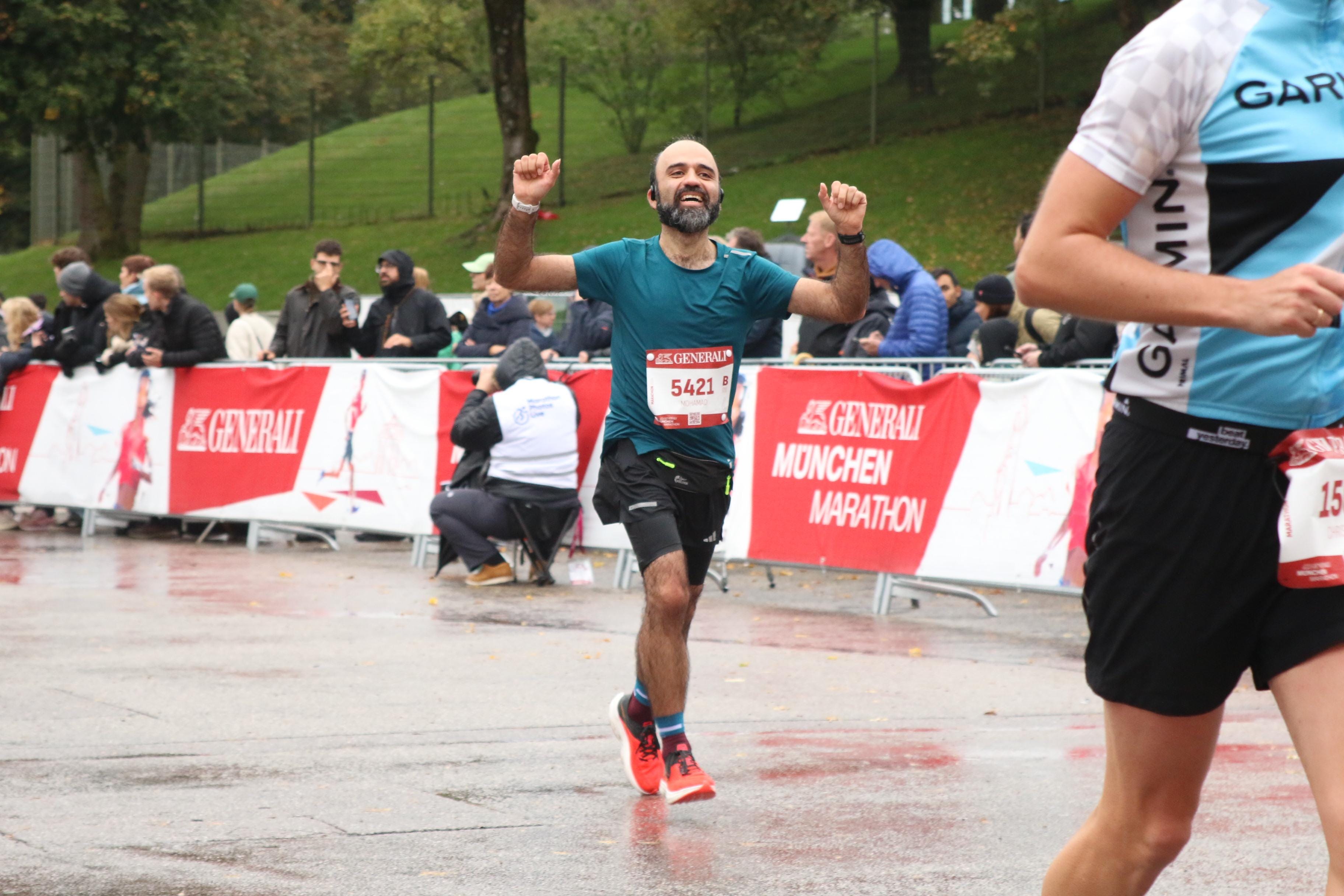
Running is hard. It destroys your knees. You lose your muscles. In the end you will never get good at it anyway or feel burned out.
That’s what the noise surrounding the running told me when I first started running, particularly when I began running a lot. And they were right … for a while.
I got injured - my knees to be exact. But also my shin, and my Achilles, and my ankles. There were moments of deep doubt, were I genuinely thought, maybe I was wrong. My mind filled with ideas of switching to lower-impact activities, like cycling and swimming. But I kept going.
Fast forward a few years, I’m not as young as I once was, but running has changed. It’s now pure joy. No debilitating injuries, no suffering.
How did I get here? What fundamental shifts happened?
If you are a beginner, this guide is for you. If you an experienced runner who keeps running into injures or plateaus, my experience might help you run pain-free and boost your performance simultaneously.
1. The Non-Negotiable Power of Easy Runs
This is arguably the most misunderstood principle in all of running. Easy runs (or recovery runs” as some like to call them) are called “Easy” for a reason. I could dive into technicalities of the Krebs cycle and what’s the purpose of zone 2 training, but I’ll save the advanced physiology for another time. Here, I’m going to focus on the critical-why, and why running these sessions too fast will eventually sabotage your progress.
Why do they matter so much? Because they typically make up about 70%-80% of your total weekly mileage. Even a small overreach on easy runs can accumulate rapidly, leading to a moment of regret in a few weeks down the line.
So, how do I actually define an easy run?
It’s not a specific heart rate or pace. An easy run is when your running feels relaxed, enjoyable, and stress-free. Your breathing is slow and comfortable.
For me the best indicators are diaphragmatic & nasal breathing, which correlates to Rate of Perceived Exertion (RPE) 2-3, where you are in low aerobic zone, and the primary energy circuit is Oxidative Phosphorylation pathway in Krebs cycle to build mitochondria and capillary density.
I run easy at RPE 2 to 3 on a Modified Borg CR10 RPE scale. That’s when the breathing is relaxed, nasal, and diaphragmatic throughout the entire session.
To give you a better perspective: When I started, my “easy pace” was 6:30, and my heart rate was wildly high (~160 BPM) just to cover a 5k. Today, my easy pace is till 6:30 /km at a much lower, comfortable heart rate, and my Marathon pace is 4:40. Nowadays I changed my Garmin’s running data screen for easy runs to just show the distance. No pace. No heart rate.
The science behind the slow pace:
Easy runs are not meant to improve your speed; they are designed to improve your endurance. They achieve this by two primary mechanisms:
Bio-Building: They increase capacity and density of mitochondria and capillaries, which fundamentally improves your body’s capability of transporting and utilizing oxygen where it’s needed.
The Recovery Catalyst: They allow you to recover, ensuring when you hit your hard, quality workouts later in the week, you are fully prepared and not running on accumulated stress and fatigue.
Run your easy days too fast and you carry over stress and fatigue into your quality sessions, and that’s where progress eventually stalls.
2. Data is Useful, but Intuition Comes First
I’m a data enthusiast. I love metrics because they are measurable, objective, and visible. Following my resting HR drop or tracking my HRV trends makes perfect sense - they provide invaluable data points for planning my daily training intensity or duration.
But this reliance on the numbers led me to ignore the elephant in the room: How does this data actually feel?
Overtime, I learned that sometimes my workout doesn’t feel quite right event when the metrics suggest otherwise. My HRV might be in range, my RHR is low, I had a good sleep - yet, somehow the training feels dull, I cannot push my heart rate as high as I normally would or expect.
The Lesson From the Shin Pain:
My shift in perspective came because of an injury. My right shin started to hurt precisely at 30-minute mark of my runs. The pain was immediate and intense, making me stop dead. The moment I stopped running the pain vanished, like nothing ever happened.
My Orthopedic doctor suspected Exertional Compartment Syndrome - a condition where the pressure builds up painfully inside the muscle compartment. The fix, or management required to radically change my routine and the way I train.
The primary way to diagnose it is to measure the pressure before and after the session to see if the increase is above a certain threshold. And the fix is typically surgery, or if you are lucky like me, you can simply live with it, and taking care of not triggering it.
My PT instructed me to dramatically slow down, building mileage only from when the pain started. While recovering from the injury, a different, more critical realization took root:
What you “feel” before or during your run can provide a more holistic picture of your fitness and readiness - you just need to learn how to read it.
I stop using “data” as a sole primary measure of my daily fitness. I began paying hyper-attention to the feeling before I laced up and the subtle shifts during the run. I learned to listen to what my body was telling me.
Don’t get my wrong, I still use data, but now it serves a complimentary role. It tracks long term-trends and overall health effect. My feeling however, can provide a much better, real-time estimate of my recovery and performance state because it incorporates hundreds of small details that wearable tech can’t possibly capture.
3. Consistency Beats the Intensity
If Principles 1 and 2 are how and what of training, Principle 3 is the mindset. It the understanding that endurance is built through patience, and methodical, sustained load.
Consistency is the greatest gift you can give your body, however this principle only works when the fist two cornerstones are in place. If you fail to respect your easy runs, or ignore the signals of pain, the accumulated stress and fatigue will inevitably force you to pull the brake for prolonged recovery periods, or worse, due to outright injury.
The Principle of Adaptation
At its heart, endurance training is about sustaining load over a long period of time to force adaptation. Whether your are aiming for a marathon or an ultra, the goal is not just to run fast for a 20 minutes 5k race, but to maintain the sustained effort and for a very long period of time, physiologically and psychologically.
I frequently see beginners make the same mistake: they focus to heavily on impressive high-intensity workouts, like intervals or tempo runs, at the expense of the slow, foundational easy runs or critical long runs. Or, they train hard for 4 few weeks and take a long, unstructured break to recover.
But what do I truly mean by consistency? I mean periodization.
Think of training as cycles. You don’t train for a year long at max output. Instead, you plan your efforts into distinct blocks:
a training season (the build phase)
a competitive (the peak phase),
and an off-season to fully recover, repair tissues, and get ready for another cycle.
The Lesson of Milo of Croton
To better understand the profound difference between temporary intensity and long-term consistency, let’s look at a story you probably heard: The legend of Milo of Croton.
The story as it goes, a young Milo finding a newborn calf near his home. He began carrying the calf on his shoulders back to herd daily. Over time, the calf grew bigger, heavier, and Milo kept carrying this increasing weight across the field. After 4 years the calf was a full-grown, heavy bull. Milo continued carrying this massive animal across the field to the herd, or in some versions across the Olympic Stadium.
Whether the story is historically accurate or not, the core lesson is undeniable: Strength, capacity, and endurance are not found in a single burst of effort, but in the gradual, sustained process of increasing load.
The Critical Contrast
Now imagine, if Milo, carried the calf for a weeks. then took a month off. When he returned, the calf would still be much heavier, and his body would lack the accumulated resilience needed to complete the task of carrying the calf.
Like many things in life, endurance capacity isn’t built over night no matter how fast or intense your best workouts are. It requires conditioning the body by gradually increasing the load over extended periods.
Conclusion: The 3 Lessons
This story ends here, but its lessons guided my entire running journey.
What I want you to take from this - whether your goal is a Sub-3 marathon or a Sub-20 5k, or simply carrying a full-grown bull - is the realization that mastery is not based on raw talent, but on disciplined process.
You can achieve peak performance by respecting these 3 lessons:
Caring for your body: Building the aerobic foundation through easy, consistent, and gradually-increasing training loads.
Listening to your body: Honoring signs of fatigue, injury, and need for rest. Data is complementary and not replacement for what you feel.
Consistency: Adhering to the long game of gradual, sustainable progression.
The Marathon isn’t won in the final mile; it’s won in the years of consistent effort that built the runner.